You were told it only ever gets worse.The science has moved on.
The Rethink Project is a health education initiative. We study how evolving scientific evidence is reshaping our understanding of health — connecting the work of leading researchers into clear, practical guides. Our first guide brings that evidence to one question many people are told to stop asking: can Type 2 diabetes be reversed?
PDF on Gumroad: 30-day, no-questions refund · PDF delivered by email within a few minutes.
Prices shown in USD. Local pricing and taxes may vary. Amazon purchases follow Amazon’s policies.
The problem was never you. It’s that the advice keeps contradicting itself.
One expert says fat, another says sugar. Headlines reverse each other by the week. Research evolves faster than anyone can follow, and each specialist sees only their corner of it. It’s no wonder people stop knowing who to trust.
The Rethink Project exists because modern scientific understanding is scattered across disciplines. Our role is simple: to connect those insights — comparing the evidence, separating what’s established from what’s still emerging, and translating it into understanding you can actually use.
You’ve probably already started this journey.
Every guide we make retraces the same path — the one you walk when a diagnosis makes you question what you’ve been told. Move through it.
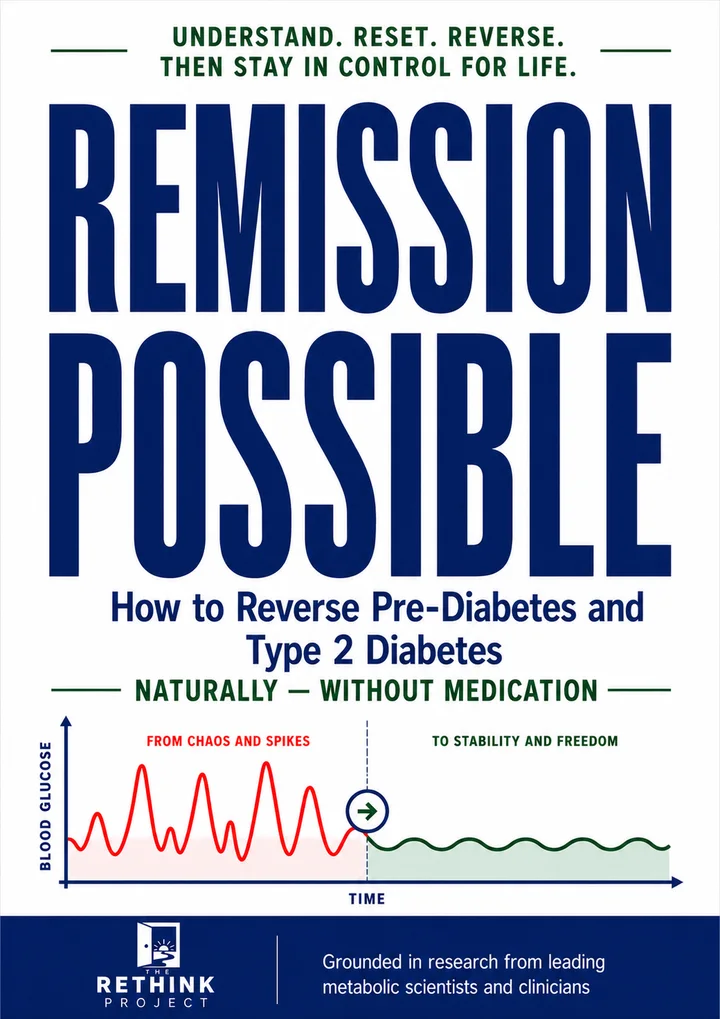
Remission Possible
Understand. Reset. Reverse. Then stay in control for life.
This isn’t another product. It’s the guide we wished someone had handed you the moment you were diagnosed — the questions you were told to stop asking, answered with the evidence.
PDF on Gumroad: 30-day, no-questions refund · PDF delivered by email within a few minutes.
Prices shown in USD. Local pricing and taxes may vary. Amazon purchases follow Amazon’s policies.
Educational information, not medical advice. Remission is defined as non-diabetic blood sugar for at least three months, off glucose-lowering medication — always achieved with your healthcare provider.
Six ideas that are hard to un-see.
Not a preview of pages — the actual ideas. Each takes a minute to understand, and changes how you read everything after it.
Diabetes doesn’t begin on the day you’re diagnosed.
For most people, insulin resistance builds quietly for years while blood tests still say “normal.” Seeing that timeline is the first step to reversing it.
Your body has a limit — and everyone’s is different.
Two people can eat the same food with completely different results. Cross your personal threshold, and extra energy stops being used — it gets stored where it does harm.
Your body isn’t broken. It’s protecting you.
“Eat less, move more” fails not because of weak will — but because high insulin keeps stored fat locked away. Lower the insulin, and the furnace lights again.
It’s not just what you eat. It’s the order.
The same plate, eaten in a different sequence, produces a different blood-sugar curve. Small lever, disproportionate effect.
Some foods spike you. Even when they shouldn’t.
Hidden sugars and refined carbs can keep insulin high all day — often in foods sold as healthy. A few swaps do disproportionate work.
A 90-day reset. A lifetime of change.
Step by step, week by week. You don’t have to figure it out alone — the plan sequences everything above into three phases.
“This isn’t about perfection. It’s about progress that your future self will thank you for.”
This is a glimpse. The guide goes deeper on every idea — with tools, meal strategies and the complete 90-day plan.
Built like a book, not a PDF.
Every idea is designed to be seen — scientific diagrams, comparisons and clean editorial frameworks that make the evidence legible at a glance.
Look under the hood of your biology — why a diagnosis is really a ten-year warning, and how the “Personal Fat Threshold” explains what’s happening inside you.
Pick up the levers of change — Food, Timing, Movement, and the silent levers of Sleep and Stress. You finish knowing exactly what to do, and why it works.
A week-by-week 90-day reset — and how to talk with your doctor about safely reducing medication as your numbers improve.
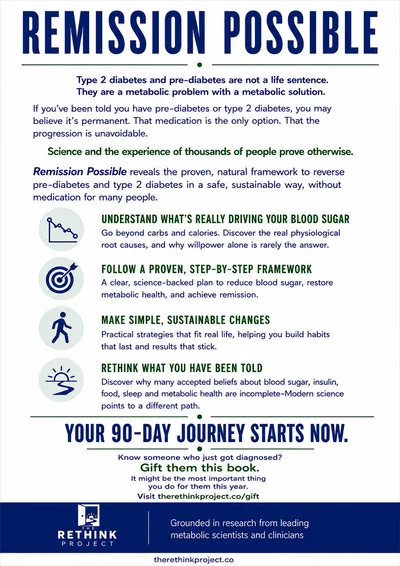
“Type 2 diabetes and pre-diabetes are not a life sentence. They are a metabolic problem with a metabolic solution.”
Pages shown are from Remission Possible, recreated and reproduced from the guide.
We don’t create the science. We help you understand it.
Every guide follows the same deliberate method — the one that makes it trustworthy.
We read the primary research across disciplines — not the headlines about it.
Where do leading researchers agree, and where does the evidence still diverge?
We find where separate fields quietly point toward the same idea.
We turn it into something clear, honest and usable — established vs. emerging, always marked.
Where our attention is turning next.
Ongoing domains of exploration — not a roadmap of future products.
Where scientific thinking is evolving.
Not a marketing list. An occasional letter that translates new research into something you can think with. No noise, no hype.
Delivered via Gumroad. Unsubscribe anytime.

You understand something now
you didn’t before.
Stay curious. Keep asking better questions. And if the science has changed — read the evidence for yourself.
PDF on Gumroad: 30-day, no-questions refund · PDF delivered by email within a few minutes.
Prices shown in USD. Local pricing and taxes may vary. Amazon purchases follow Amazon’s policies.